No Virginia, these
aren't meteorites, Page 2
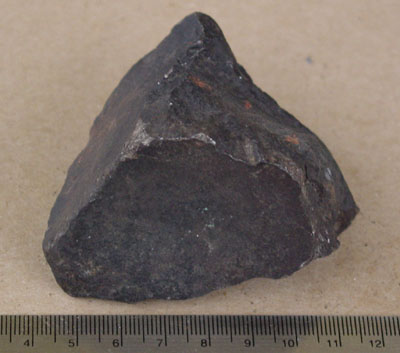
FERROCHROMANGANESE (below):
This is one of the most commonly
misidentified 'meteorites' in Oregon.
Ferrochromanganese is an artificial alloy
made in the making of steel.
To the left is a typical sample of
ferrochromanganese, showing a dark
oxidized surface. If you look closely,
you can see shiny edges where the oxidized
coating has been removed by
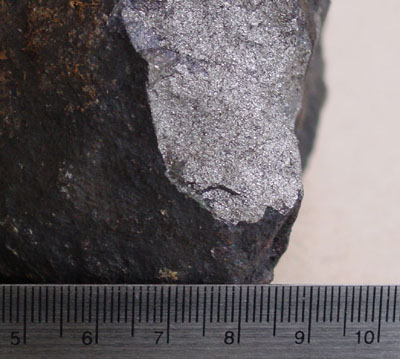
abrasion. The image to the right
is of a sample which has been broken
open, exposing the interior.
The interior is shiny, silver, and has a granular
texture that has been described as
"sugary". Another diagnostic feature of this
material is the presence of tiny holes
or vesicles (bottom image). Such vesicles
are almost never found in meteorites.
|
|
 |
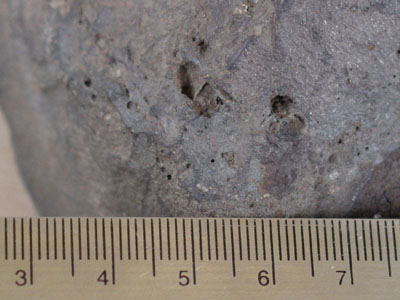
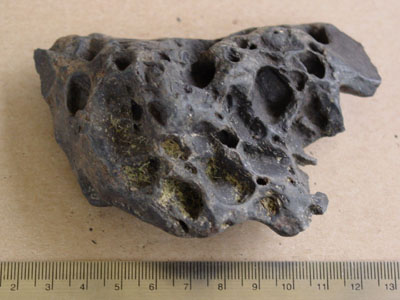
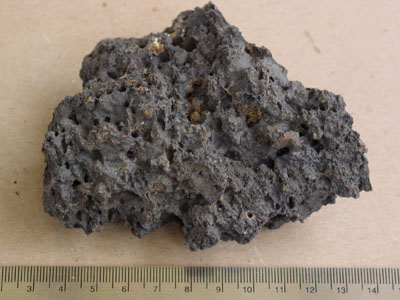
VOLCANIC ROCKS (below):
One problem with finding meteorites in the Pacific
Northwest is the abundance of dark-colored
volcanic rocks. The picture on
the left shows a vesicular basalt,
while the picture on the right shows scoria
(light-weight volcanic cinder).
Many basalts lack vesicles and are simply solid
dark rocks.
MORE "METEOR-WRONGS"

Page last modified December 2, 2010

|