The
Erwin F. Lange Endowment was established in 2005 to invest in the long-term
growth of the Cascadia Meteorite Laboratory (CML).
Donations are added to the fund's principal,
with the interest on this principal available to cover laboratory expenses.
In 2005, CML became an official respository
for the type specimens of some newly classified meteorites. We maintain
these and many other specimens, and loan material to researchers at other
institutions.
Please help support
your lab.
You can make a difference. You can
help by making a check out to:
PSU Foundation/
Erwin F. Lange Endowment
and mailing it to the address given below.
You can also use our giving
form or donate
on-line.
Your support is greatly appreciated!
Portland State University
is a 501(c)(3) non-profit organization. Your donation to the Cascadia
Meteorite Laboratory is tax deductible.
Our address:
Cascadia Meteorite Laboratory,
Dept. of Geology,
Portland State University,
17 Cramer Hall,
1721 SW Broadway,
Portland, OR 97207-0751 |
This endowment was started by CML
member and PSU alumnus Richard N. Pugh, in honor of his former advisor
Erwin F. Lange.
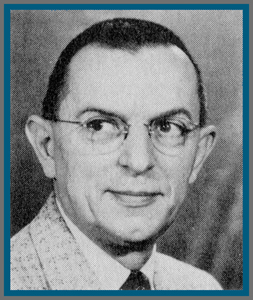
Picture of Erwin F.
Lange
from the Portland
State College 1960 yearbook
Erwin F. Lange was a passionate scientist
with an interest in meteorites and the history of science. He encouraged
a number of his students, including Richard Pugh, to become science teachers.
He began his career as a chemistry instructor
at Vanport College (a precursor to PSU) in 1948. When the college
moved to downtown Portland and became Portland State College, Dr. Lange
moved with it and became the Head of the General Sciences Department.
In the 1960s, Portland State College became Portland State University and
Dr. Lange became the Assistant Dean of Science. He taught classes
in physical science, the history of science, and meteorites, and was always
on the lookout for potential teachers among his students. He also believed
in educating the public about meteorites.
1968: The Year of
the Meteorite
In 1968, he published "A Collection of
Articles on Meteorites" as Miscellaneous Paper #11 in The Ore Bin,
a publication of the State of Oregon's Department of Geology and Mineral
Industries.
In his introduction, he states: "The year
1968 has been designated in Oregon as the year of the meteorite by a committee
consisting of Hollis M. Dole, State Geologist, Phil F. Brogan, science
writer and former associate newspaper editor at Bend, and the writer.
This group firmly believes that there are in Oregon undiscovered meteorites
that might be found if many people became more observing of their surroundings,
and the group also feels that there may be undescribed or unreported meteorites
in the possession of people who are unfamiliar with their importance to
science."
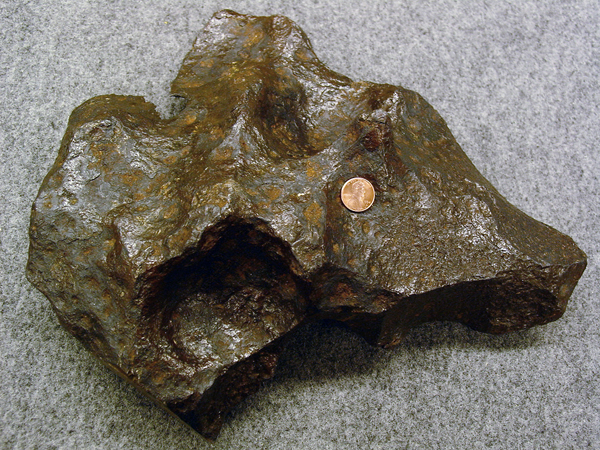
The first meteorite
in the Portland State University/
Cascadia Meteorite
Collection is a 35 lb Odessa (Texas)
iron meteorite (IAB)
purchased by Erwin F. Lange in 1968.
A U.S. penny (1.8
cm in diameter) is shown for scale.
As a result of Lange's efforts during The
Year of the Meteorite, a 35 lb iron meteorite (Odessa, Texas) was brought
in to Portland State. Dr. Lange purchased this meteorite for $200.
This became the first meteorite in what would later be the Cascadia Meteorite
Laboratory's collection.
|

